HISTORY · PINACOTECA
92 paintings, a memory in colour
The colonial art of the monastery in three halls
Three halls — two long parallel vaults and one perpendicular — house 92 paintings and 13 sculptures. Their acoustics also make the space a venue for baroque concerts.
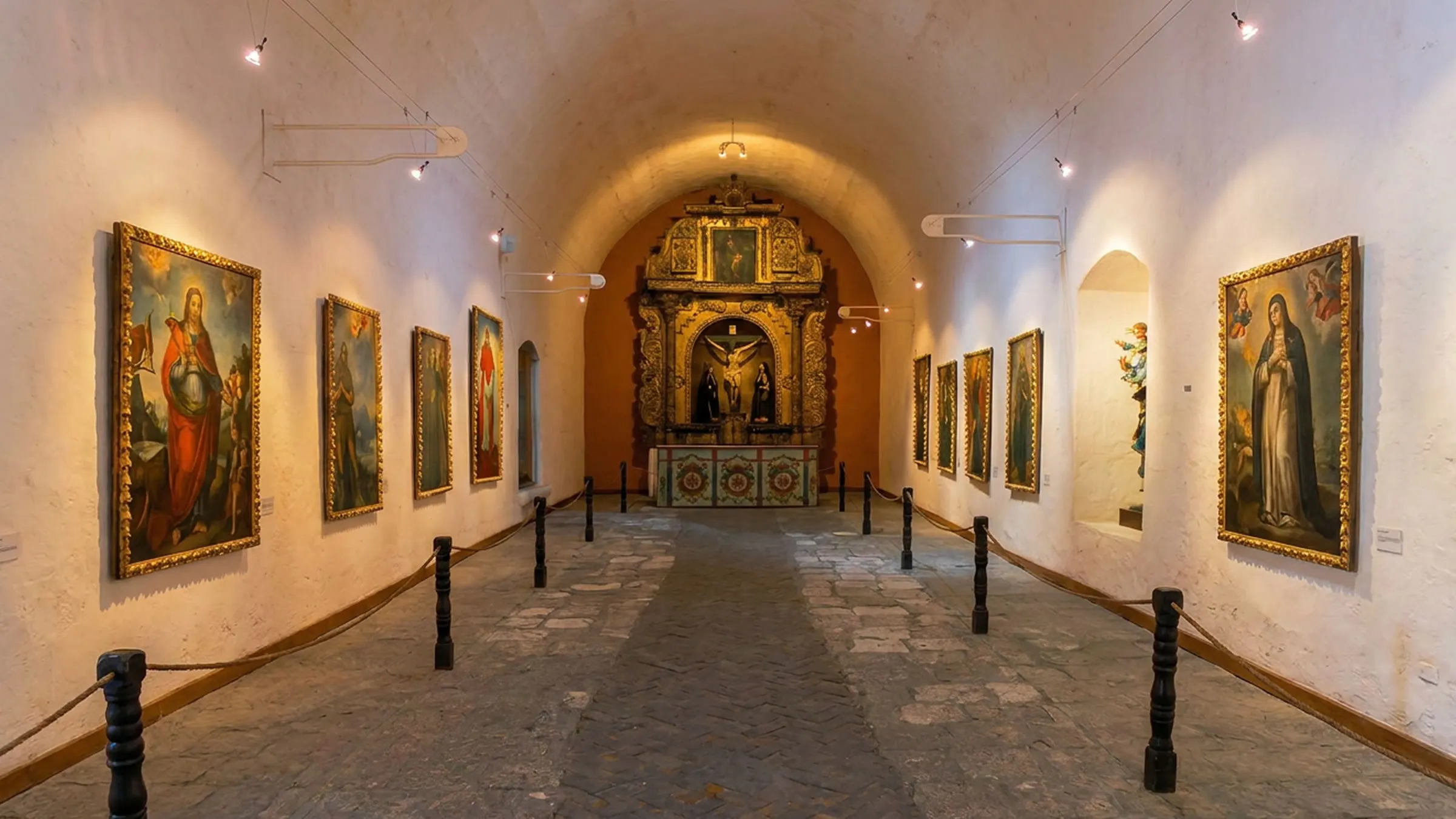
The pinacoteca of the Monastery of Santa Catalina holds 92 paintings and 13 sculptures that bear witness to the richness of viceregal Andean art. Most of the paintings belong to the Cuzco school, a pictorial movement that developed in Peru during the 17th and 18th centuries from the encounter of Italian, Flemish and Spanish traditions with the sensibility of indigenous artists.
The works converse in carefully measured low light, supported by sillar vaults that also form a remarkable acoustic chamber. For that reason, the pinacoteca regularly hosts baroque and sacred music concerts.
Three halls, one collection
The space is laid out in three connected halls: two large parallel vaults and a perpendicular one that articulates the route, arranged in the shape of a cross and tied to two of the arcades of the Main Cloister and the Cloister of the Orange Trees. Stripped of its original stucco, the bare sillar is left visible, creating a sober and majestic setting. The paintings depict Marian scenes, portraits of saints, virgins and angels, with elements of Andean iconography — flowers, birds, solar symbols — that define the singularity of Cuzco art.
A collection larger than the hall
The 92 works on display are the visible face of a much larger heritage: when restoration work began on the monastery, before its opening to the public on 15 August 1970, a collection of around 400 pieces — most of them religious in subject — was found scattered throughout the precinct, all examples of viceregal Peruvian painting. They were restored or "refreshed" by expert hands to bring back their original look, and today they are distributed across the pinacoteca, the cloisters, the church and other spaces of the monastery.
Painting styles
The monastery preserves works from the various artistic styles that developed during the viceroyalty and the early years of the republic: Mannerist canvases brought from Italy in the early days, paintings with a clear influence of the Spanish school — among them a Saint Michael the Archangel that is unmistakably Zurbaranesque — and, of course, a substantial collection from the Cuzco school, the highest expression of the fusion of the spiritual values of two cultures.
Conservation and access
Every canvas is part of a careful preventive conservation programme. Lighting, humidity and temperature are monitored to ensure the lasting preservation of a heritage that belongs to every Peruvian.
"The buildings of the historic centre of Arequipa are representative of the fusion of European and indigenous building techniques."
A few featured works
This is just a small sample. The full collection can be admired during your visit.