
EXPLORE THE MONASTERY
20,000 square metres, four districts, one unique experience
The monastery was built mirroring the urban layout of colonial Arequipa. Its streets, cloisters and patios form a miniature city you can explore at your own pace.
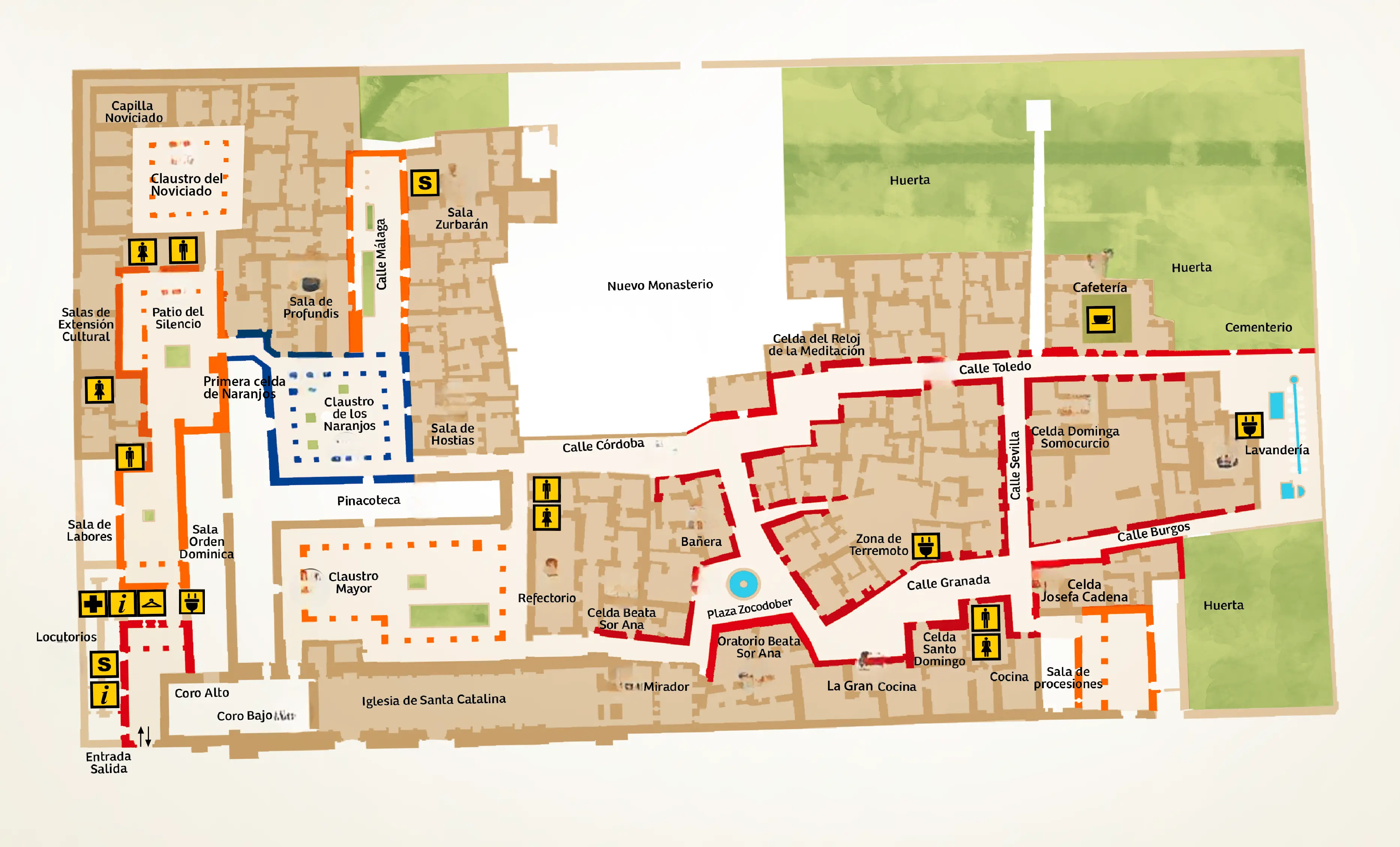
Click any point on the map to read about it and listen to the audio guide.
FULL ROUTE
The 32 spaces in visiting order
A 1.5- to 2-hour tour that leads you through cloisters, inner streets, halls and patios. Follow the suggested order or wander at your own pace.
- 01
Hall
Visiting Room
From the very beginning, women of diverse social strata took the veil as cloistered nuns, never to go back…
- 02
Hall
The Workroom
This room was used to entertain important visitors such as the Bishop, and also as a place for the nuns to…
- 03
Patio
Patio of Silence
The arch of Silence gives entrance to the monastery and reminds the visitor that the house is still dedicated…
- 04
Cloister
Novices' Cloister
The Cloister of the Novices is small, well proportioned, with ridged vault arches in brick, stone-faced walls…
- 05
Cloister
Cloister of the Orange Trees
This cloister surrounds an orange orchard.
- 06
Cell
First Cell of the Orange Trees
When the monastery was founded, the nuns professed their vows and rendered their dowries.
- 07
Hall
De Profundis Chamber
The name of this long room with a vaulted dome alludes to Psalm 130: "Out of the depths I cry to thee, O…
- 08
Street
Málaga Street
The six streets of the remarkable citadel of Santa Catalina hold rows of little houses that were first roofed…
- 09
Street
Zurbarán Room
This room was once the convent infirmary.
- 10
Street
Córdoba Street
This street runs at the foot of a long white wall, embellished with latticed windows and geranium pots,…
- 11
Hall
Chamber of the Holy Host
At an initial stage this cell was shared.
- 12
Street
Toledo Street
Changing lights and shadows and a clear sky emphasise the admirable architecture of Toledo Street, coloured…
- 13
Cell
Meditation Clock
In the second room, inside a display case, we find the Meditation Clock — a fine piece crafted by the nuns…
- 14
Street
Sevilla Street
Sevilla Street, the fourth in the monastery, was once the most important: this is where the new postulants…
- 15
Cell
Mother Somocurcio's Cell
The cell of this nun, Mother Somocurcio, is an ample property located on Sevilla Street.
- 16
Service
Café
A space restored in 2001, today the café — where visitors can take a break and enjoy a drink, snack or…
- 17
Patio
The Cemetery and the Laundry
A plain, austere gateway crowned with a small cross, at the end of Toledo Street, opens onto the cemetery,…
- 18
Street
Burgos Street
The old vegetable garden is partly visible upon turning onto this street.
- 19
Cell
María Josefa Cadena's Cell
At the corner of Sevilla and Burgos, turning left, lies the cell of María Josefa Cadena.
- 20
Street
Granada Street
One of the favourite and most photographed corners of the monastery is the final stretch of this street, from…
- 21
Hall
Processions Hall
The city's religious life is expressed in many feast days held in honour of its patron saints, with…
- 22
Hall
The Great Kitchen
Built in the 17th century, the kitchen was in fact the very first chapel in the monastery, later destroyed by…
- 23
Hall
Santo Domingo Hall
A space distinguished by the embroidery work made by the nuns, as well as by the portrait of the monastery's…
- 24
Square
Zocodover Square
This little square is surrounded by red-painted walls, over which one can see the monumental dome of the…
- 25
Cell
The Nuns' Bathtub
A bathtub used by the nuns, where two could bathe at the same time — one on each side of the basin, each…
- 26
Cell
Sor Ana's Oratory
These cells were recently restored to house a series of objects connected with the life of Blessed Ana de los…
- 27
Cell
Cell of the Blessed Ana de los Ángeles
Born into a distinguished and wealthy local family, Ana de los Ángeles Monteagudo was taken to the monastery…
- 28
Hall
Refectory
The nuns' refectory has a high barrel-vaulted ceiling marked with the JHS monogram of Jesus Christ.
- 29
Cloister
Main Cloister
Built between 1715 and 1721, this cloister is the largest of the three in the monastery.
- 30
Temple
High Choir
A wooden handrail runs along the inner eaves of the High Choir.
- 31
Temple
Lower Choir
Here the ceremonies of vows, profession of faith and funeral rituals were celebrated, along with council…
- 32
Hall
Art Gallery
The old community dormitory is today the monastery's Art Gallery.
READY TO VISIT
Book your visit to the monastery
Buy your ticket online and plan your tour. The visit takes around 1.5 to 2 hours.